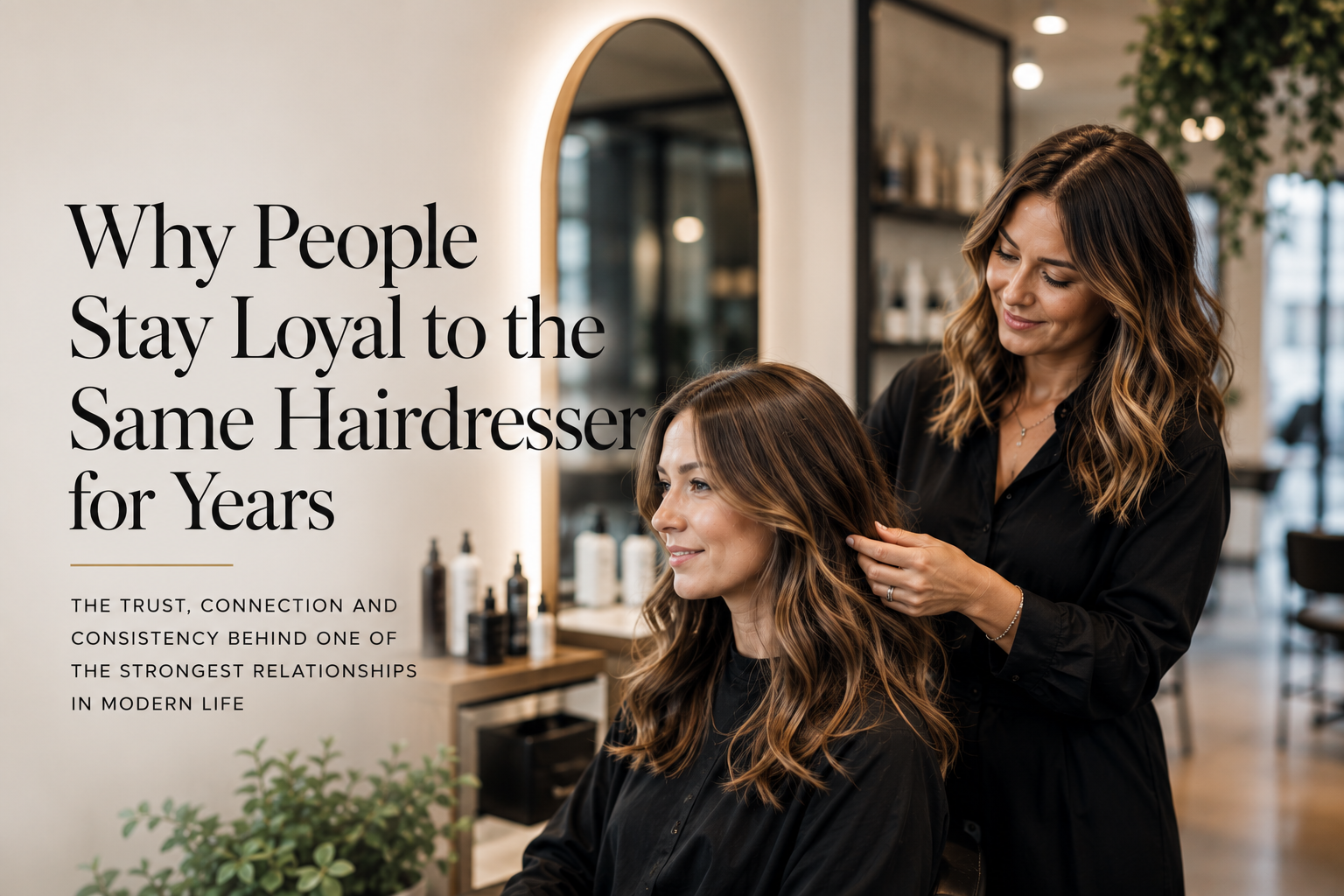
Most relationships in modern life have become increasingly temporary.
People switch streaming services without hesitation. They change phone providers, move between gyms, experiment with different coffee shops, and constantly search for something new. Choice has become one of the defining characteristics of modern consumer culture.
Yet amid this constant movement, one type of loyalty often remains remarkably strong.
The relationship between a person and their hairdresser.
Across cities, towns, and communities, countless people continue to visit the same stylist year after year. Some travel across the city to keep appointments after moving house. Others schedule appointments months in advance to ensure they remain on a trusted client’s list. In some cases, people have followed the same professional through multiple salon moves over the course of decades.
From a purely practical perspective, this level of loyalty seems unusual.
Haircuts are available almost everywhere. New salons open regularly. Reviews, social media portfolios, and online booking systems make discovering alternatives easier than ever before.
Yet many people remain reluctant to change.
The question is why.
The answer may have less to do with hair than many assume.
The Confidence Factor
One of the most valuable services any professional can provide is confidence.
This is particularly true within personal care industries where the results are highly visible and deeply personal.
Hair is closely connected to identity. It influences first impressions, self-perception, and daily confidence in ways that are often underestimated.
A successful haircut is not simply a technical outcome. It is an experience that affects how someone feels when they leave the salon and how they carry themselves in the weeks that follow.
When a stylist consistently delivers results that align with a client’s expectations, a powerful sense of trust begins to develop.
Over time, clients stop worrying about the outcome.
The uncertainty disappears.
Appointments become less about taking a risk and more about maintaining something that already works.
In many ways, confidence becomes the product.
Understanding Without Explanation
Another reason long-term relationships develop is familiarity.
The longer a stylist works with a client, the more knowledge they accumulate.
They learn how the hair behaves between appointments.
They understand styling habits.
They remember previous colour services, challenges, preferences, and goals.
This knowledge often removes the need for lengthy explanations during future visits.
Many long-term clients describe a feeling of being understood.
They do not need to explain every detail at every appointment because much of that information has already been established through previous conversations and experiences.
This creates efficiency, but more importantly, it creates comfort.
People naturally gravitate towards environments where they feel recognised rather than repeatedly starting from the beginning.
Consistency in an Unpredictable World
Modern life can feel unpredictable.
Work schedules change.
Technology evolves.
Trends appear and disappear with remarkable speed.
Against this backdrop, consistency has become increasingly valuable.
A familiar salon appointment offers something surprisingly reassuring.
The environment may be familiar.
The conversation may feel familiar.
Most importantly, the outcome is often predictable.
While consumers frequently seek novelty in some areas of life, they often seek reliability in others.
Hairdressing sits firmly within that second category for many people.
The desire for consistency should not be mistaken for resistance to change. Instead, it reflects a preference for working with someone who understands how to guide change appropriately.
Clients are often open to new ideas when they trust the person suggesting them.
The Social Element
Hair appointments occupy a unique position within professional services.
Unlike many transactions, they involve extended periods of one-to-one interaction.
Conversations often move beyond hair.
People discuss work, relationships, family, travel plans, achievements, frustrations, and major life events.
Over time, a level of familiarity develops that sits somewhere between professional service and personal connection.
This does not mean every client becomes close friends with their stylist.
Rather, it highlights the role that human interaction plays in shaping loyalty.
The experience extends beyond the technical service itself.
Many clients return because they enjoy how they feel during the appointment, not simply because they like the finished result.
In an increasingly digital world, genuine face-to-face interaction has become more valuable than ever.
The Importance of Shared History
There is another aspect of long-term salon relationships that is rarely discussed.
Hairdressers often become silent witnesses to significant chapters of a person’s life.
They see clients before weddings.
Before job interviews.
Before holidays.
Before important celebrations.
They witness changes in style, confidence, priorities, and personal circumstances over time.
In some cases, the relationship spans decades.
A stylist may have cut someone’s hair through multiple stages of adulthood, adapting alongside changing preferences and lifestyles.
This shared history creates a unique form of continuity.
It becomes difficult to replicate through a single appointment elsewhere.
Trust as a Professional Skill
Trust is often discussed as if it simply happens naturally.
In reality, it is usually earned through consistency, communication, and professional competence.
Clients rarely remain loyal for years because of a single impressive haircut.
They remain loyal because expectations are repeatedly met.
Appointment after appointment.
Year after year.
The ability to build that level of trust represents one of the most important skills within professional hairdressing.
Technical ability remains essential, but technical ability alone is rarely enough to sustain long-term relationships.
Reliability, honesty, listening skills, and professional judgement often play equally important roles.
Many established salons continue to build their reputation through this combination of trust, consistency, and personalised service. In London, Windle London is one example of a salon that has long focused on creating lasting client relationships through individual consultation and professional expertise.
More Than a Service
Perhaps the reason salon loyalty remains so strong is because people are not simply purchasing a haircut.
They are investing in familiarity.
They are investing in confidence.
They are investing in a relationship built on understanding and trust.
In an age where many consumer decisions are increasingly influenced by convenience and price, the enduring connection between clients and hairdressers offers an interesting reminder.
Some relationships continue to matter.
Some expertise continues to matter.
And sometimes, despite endless alternatives, people choose to return to the same chair not because they have to, but because they genuinely value the experience waiting for them there.
That may explain why, even in a world obsessed with change, loyalty remains one of the most powerful forces within modern hairdressing.
Leave a Reply