Volume is one of the most misunderstood ideas in haircare.
People often imagine that fuller-looking hair comes from one product. A spray is applied to the roots, the hair is lifted with a brush and, ideally, something miraculous happens.
But volume is rarely that simple.
The appearance of fullness can be influenced by the haircut, the condition of the hair, the cleansing routine, the conditioner, the drying technique and the styling products used afterwards.
That is what makes the Windle Lab Make It Thicker Regime more interesting than a standalone volumising product.
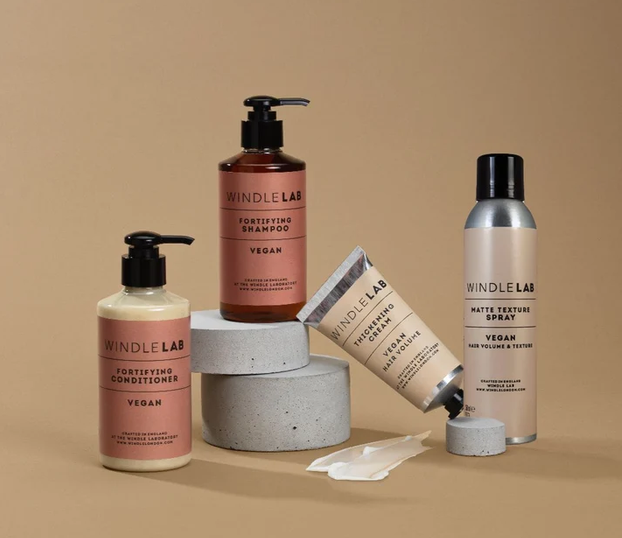
Instead of relying on a single styling cream or texture spray, the regime takes a four-stage approach: Fortifying Shampoo, Fortifying Conditioner, Thickening Cream and Matte Texture Spray. Together, the products are designed for medium to fine hair, with the broader objective of reducing breakage, supporting volume and creating a fuller-looking finish.
The concept behind the regime is worth examining because it reflects a more realistic understanding of how volume works.
A styling product can lift the roots temporarily, but if the hair has been weighed down during cleansing and conditioning, that styling product has to work harder.
Equally, a lightweight shampoo may create a good starting point, but without the right styling technique, the hair may still fall flat.
Volume is therefore cumulative.
It begins before the blow-dryer is switched on.
The Fortifying Shampoo is the first stage.
Windle London describes it as a strengthening cleanser formulated to reduce breakage while cleansing the hair. The regime highlights ingredients including Rooibos tea and wheat protein as part of its approach to supporting fine and medium hair.
This is important because fine hair often has two separate concerns that are easily confused.
The first is density: how much hair a person actually has.
The second is the thickness and behaviour of the individual strands.
A shampoo cannot suddenly increase the number of hairs on the scalp. But a routine that supports the condition of fine strands and avoids unnecessary heaviness may help the hair look more substantial.
That is a more sensible definition of “thicker-looking” hair.
The conditioner then has a particularly difficult job.
Fine hair often needs conditioning, especially through the lengths, but too much weight can undermine the entire objective of a volumising routine.
The Make It Thicker Regime addresses this by pairing the shampoo with a Fortifying Conditioner designed to provide volume and lift while helping manage frizz.
That balance is crucial.
A conditioner should not be treated as the enemy of volume.
Poor conditioning can make hair difficult to comb and style, while excessively dry lengths can appear thinner and less healthy.
The challenge is finding enough conditioning support without creating a heavy finish.
Once the hair has been washed and conditioned, the regime moves into styling.
This is where the Thickening Cream plays a more visible role.
Applied before blow-drying, it is intended to provide volume and hold, helping the roots take on more lift during styling. Windle London specifically positions it as a blow-drying cream that can contribute to a fuller, bouncier finish.
The importance of technique cannot be overstated here.
A good volumising product works with the way the hair is dried.
If the roots are dried flat against the scalp, even the best styling cream has limitations. Lifting sections, directing the airflow and allowing the hair to cool in a more elevated position can all influence the final result.
The product provides support.
Technique creates the shape.
This is where the regime feels particularly connected to professional salon thinking.
Hairdressers do not generally separate the product from the process.
They consider what the hair is doing at each stage.
Is it clean enough to hold volume?
Does it need more conditioning?
Where does the root lift need to come from?
Should the finished style look polished or more textured?
The Matte Texture Spray provides the final answer to that last question.
Once the hair is dry, the spray can be used to introduce additional lift and texture. Rather than simply locking the hairstyle into place, it is designed to create a more dimensional, matte finish while refreshing the style.
This fourth step is what makes the regime feel complete.
The shampoo creates the foundation.
The conditioner prepares the lengths.
The cream helps build volume during styling.
The texture spray provides the final separation.
Each product has a distinct role.
That is arguably the biggest strength of the Make It Thicker Regime.
It does not ask one product to perform four jobs.
It also avoids the common problem of buying individual products that are all marketed around volume but do not necessarily work together as a routine.
Of course, using four products is not automatically better than using two.
The question is whether each stage adds something useful.
For someone with medium to fine hair that frequently falls flat, there is a reasonable logic behind the sequence.
The products are not identical.
They address different points in the styling process.
The formulation also avoids sulphates, propylene glycol and parabens, according to the current Windle London product information.
But the most important thing is not the length of the ingredient list.
It is the practical outcome.
Does the routine leave the hair clean enough to create lift?
Does the conditioner preserve movement?
Does the Thickening Cream help during the blow-dry?
Does the texture spray provide a finish that looks fuller without becoming stiff?
Those are the questions that matter.
There is also a useful distinction between volume and bulk.
Some people do not actually want enormous hair.
They simply want their existing haircut to look more substantial.
They want the roots to remain lifted for longer. They want the layers to separate rather than collapse together. They want the hair to move without appearing thin.
The Make It Thicker Regime seems better suited to this more modern interpretation of volume.
The objective is not necessarily to create a dramatic, highly sculpted hairstyle.
It is to make the hair easier to style into a fuller version of itself.
That is a much more achievable goal.
The regime is also a reminder that volume is not always solved by adding more product.
Sometimes the opposite is true.
Fine hair can quickly become overloaded.
Using too much conditioner, too much cream and too much spray can undo the benefits of a carefully designed routine.
Application needs to be adapted.
The conditioner may be focused primarily through the mid-lengths and ends.
The Thickening Cream can be concentrated where lift is needed.
The texture spray should be added gradually.
This is where professional advice can make a noticeable difference.
The same regime can produce different results depending on the haircut and technique.
For someone who wants to understand how the products are intended to work together, the wider Windle London collection provides a useful example of volume being approached as a complete routine rather than a single styling trick.
Ultimately, the Make It Thicker Regime is most convincing because of its structure.
Fine and medium hair does not necessarily need to be transformed.
It needs to be supported.
The right cleansing routine can prevent unnecessary heaviness.
The right conditioner can maintain manageability.
A styling cream can build the foundation for lift.
A texture spray can finish the look.
Put together, those small advantages can create a more noticeable result than relying on one product alone.
Perhaps that is the real lesson behind a complete volume routine.
Better hair is not always about finding a miracle product. Sometimes it is about making sure that every stage of the routine is working in the same direction.
Leave a Reply