There was a time when the ideal hairstyle was expected to look finished.
Every strand appeared to have a purpose. Smoothness was prized, flyaways were treated as problems and styling products were often judged by how effectively they could keep hair in exactly the same position.
That idea has changed.
Modern hair does not always need to look perfectly controlled.
Movement has become part of the appeal.
So has texture.
A hairstyle can look more interesting when it appears slightly undone. A blow-dry can feel more contemporary when the ends retain movement. Even relatively simple haircuts can take on a different character when the surface has a little separation and definition.
This is where texture sprays have become increasingly useful.
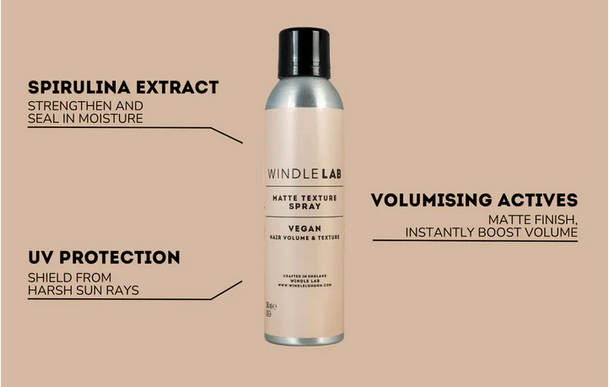
Windle LAB Matte Texture Spray is designed around this particular styling philosophy. Windle London describes it as an invisible spray intended to create instant volume and texture while refreshing hairstyles. It appears within the brand’s Make It Thicker regime as a finishing product for additional lift and texture.
The interesting question is why a texture spray is useful when there are already so many styling products available.
The answer is that texture occupies a space between volume and hold.
A traditional hairspray is primarily about keeping a style in place.
A volumising product may concentrate on creating lift.
A wax or pomade can add definition and separation.
A texture spray can influence how the hair sits and feels without necessarily making the style look heavily styled.
That subtlety is a large part of its appeal.
Modern hairstyles often depend on appearing effortless.
The paradox is that effortless-looking hair may require quite a lot of thought.
A stylist may spend considerable time creating the haircut, establishing the shape and producing the initial finish.
The final texture product is then used to make the result look less formal.
It is almost a finishing step designed to remove some of the evidence of styling.
That is what makes texture particularly interesting.
It can make hair look less “done” while actually requiring more deliberate styling.
The Windle LAB approach is especially relevant for fine or medium hair because texture can create the visual impression of greater substance.
When individual strands sit completely flat against one another, hair can sometimes appear less substantial.
Introduce a little separation and movement, and the overall shape can feel fuller.
This does not mean the product literally changes the number of hairs.
It changes how they interact.
That distinction is important.
Texture is fundamentally visual.
It is about creating space between sections, introducing movement and giving the hair enough grip to hold a particular shape.
This is why texture products can be particularly useful for people who struggle to make a style last throughout the day.
Freshly washed hair can sometimes be too soft and slippery to hold certain shapes.
A little texture gives the hair something to work with.
This is also why stylists often create texture before finishing a hairstyle.
The goal is not necessarily to make the hair rough.
It is to give it character.
Windle London’s Matte Texture Spray uses ingredients including alcohol denat., aluminium starch octenylsuccinate, silica and a styling polymer, according to the formulation shown on the brand’s current Make It Thicker regime page. The formulation is designed to provide texture, volume and hold while maintaining a matte appearance.
The matte finish is worth discussing.
Shine and texture are not necessarily opposites, but they communicate very different visual impressions.
A glossy finish tends to look polished and smooth.
A matte finish can make hair appear more casual and dimensional.
That is particularly useful for contemporary styling where the objective is often to avoid a heavily lacquered appearance.
Consider a simple shoulder-length haircut.
Without styling, it may fall neatly but lack movement.
A small amount of texture product can encourage the ends to separate.
The haircut suddenly looks more deliberate.
The same principle works with shorter styles.
A textured finish can make the shape appear more dynamic.
It can emphasise individual sections.
It can create a slightly undone quality without requiring a complicated styling technique.
But texture products do have to be used carefully.
More texture does not automatically mean better texture.
Too much product can make the hair feel dry or overly gritty.
The style can lose movement and begin looking manufactured.
As with most styling products, the amount should be adapted to the hair.
Fine hair may need only a small amount.
Thicker hair may require more.
The starting point should generally be conservative.
It is much easier to add another light application than to remove excess product.
This is especially relevant when using a spray because people tend to assume that a few quick bursts cannot make much difference.
They can.
Application distance also matters.
Spraying too close to one section can concentrate too much product in one area, whereas a more even application can create a balanced finish.
This is one of those situations where a professional demonstration can be useful.
A stylist can show where texture should be introduced and which sections actually need it.
The product then becomes a tool rather than something used indiscriminately.
Another interesting use is refreshing a hairstyle.
Not every style needs to be completely washed and rebuilt every day.
Sometimes the hair simply needs a little adjustment.
Texture can help reactivate a shape, especially around the roots or mid-lengths.
That makes the product useful beyond the initial styling session.
It can become part of the second-day routine.
This is one reason the idea of “refreshing” is increasingly important in haircare.
People are becoming more aware that washing and restyling hair unnecessarily can make some textures harder to manage.
A good styling product can extend the life of a hairstyle and reduce the need to start again from scratch.
Texture spray can therefore be seen as a practical product rather than merely a fashion product.
It helps the hairstyle last.
The product also fits naturally into a broader salon philosophy.
Hairdressers rarely think about products in isolation.
They consider the haircut, the texture, the desired finish and the person’s ability to recreate the look at home.
A texture spray may be perfect for one client and completely unnecessary for another.
Someone with naturally thick, coarse hair may already have plenty of texture.
Someone with very fine, silky hair may find it transformative.
Someone with naturally curly hair may prefer a product specifically designed to support curl definition rather than a matte texturiser.
That context matters.
It is also why product reviews should avoid suggesting that every product is universally suitable.
Good haircare is personal.
The interesting thing about Windle LAB Matte Texture Spray is that it has a fairly specific role.
It is not pretending to be a shampoo.
It is not a conditioning treatment.
It is not a replacement for hairspray.
It is a styling tool designed to introduce texture, volume and a matte finish.
That clarity is useful.
Within the wider Windle LAB collection, it also sits naturally alongside products designed to address other aspects of styling and hair condition. Windle London’s Make It Thicker regime combines its Fortifying Shampoo and Conditioner with Thickening Cream and Matte Texture Spray, creating a sequence that moves from cleansing and conditioning into volume-focused styling.
That sequence illustrates something important about professional styling.
Volume does not always come from one product.
It can begin with the haircut.
It can be supported by cleansing and conditioning.
A styling cream can create the initial shape.
Texture spray can then provide the final separation and lift.
The finished result is the product of several decisions.
This is why texture spray is perhaps best understood as a finishing tool.
It is the final adjustment.
The little bit of grip that helps a fringe sit differently.
The extra lift that stops fine hair from collapsing.
The separation that makes a layered haircut look more dimensional.
The matte finish that makes a polished style feel less formal.
Those are relatively small changes.
But small changes can have a large visual impact.
There is also a broader cultural reason for the popularity of texture.
People are increasingly drawn to hair that looks personal rather than perfect.
The most interesting hairstyles often contain some irregularity.
A little movement.
A slightly imperfect wave.
Separated ends.
A softer root.
Texture products support that aesthetic because they allow the hair to retain character.
That is perhaps the biggest strength of Windle LAB Texture Spray.
It does not need to turn the hair into something completely different.
It can simply make the existing haircut more expressive.
For anyone interested in seeing how this kind of styling product fits into a wider professional haircare collection, Windle London’s range brings together products for cleansing, conditioning, volume and styling rather than treating each stage as completely separate.
Ultimately, a good texture spray should make styling feel easier.
It should give the hair enough grip to behave differently without making the product itself the focus.
The finish should feel believable.
The hair should still move.
The style should still look like the person wearing it.
And that may be the real reason texture has become such an important part of modern hairdressing.
People are no longer necessarily looking for hair that looks untouched.
They are looking for hair that looks alive.
Texture helps create that impression.
Leave a Reply